The Complete Guide to Geotechnical Soil & Rock Description (AS1726-2017)
 ·
28 March 2026
·
No Comments
·
28 March 2026
·
No Comments
- Introduction: Why Standardised Description Matters
- Soil Description — The Full Framework
- Soil Classification System Explained
- Grain Size, Shape and Particle Characteristics
- Consistency, Density and Moisture Condition
- Geological Origin and Formation Terms
- Plasticity, Colour and Structure
- Organic Soils, Peat and Artificial Fill
- Rock Description — The Complete Approach
- Rock Types: Sedimentary, Metamorphic and Igneous
- Rock Strength and Weathering / Alteration
- Rock Mass Defects — Types, Planarity and Roughness
- Duricrusts, Carbonate Soils and Cementation
- Field Sampling and In-Situ Testing
- Drilling Methods, Support and Excavation Resistance
- Core Recovery Indices: TCR, SCR and RQD
- Groundwater Observations During Drilling
- Practical Tips for Better Site Logging
Introduction: Why Standardised Description Matters
Geotechnical site investigation is the foundation upon which every engineered structure ultimately rests — quite literally. The quality of information gathered during a ground investigation directly governs the reliability of subsequent analyses, the economy of a design, and the safety of the finished work. Yet despite the enormous downstream consequences, the raw data produced on a site investigation are words and numbers recorded on a log sheet, usually by a single person standing next to a drilling rig in conditions that may be muddy, cold, hot, or chaotic.
The challenge is deceptively simple to state: how do we ensure that a description recorded by one engineer on one site can be interpreted consistently and accurately by another engineer in an office, by a laboratory technician preparing test specimens, or by a contractor planning earthworks? The answer lies in standardisation — agreed conventions, shared vocabulary, and documented procedures that eliminate as much subjective variability as possible.
In Australia, the governing standard for geotechnical site investigation is AS1726-2017, published by Standards Australia. This document replaced the earlier AS1726-1993 and introduced meaningful changes to how soils are classified — particularly the threshold at which a material is considered fine-grained rather than coarse-grained. Understanding these changes is important not only for anyone logging ground investigation data today, but also for anyone interpreting older logs prepared under the 1993 standard.
This guide provides a comprehensive reference for practising geotechnical engineers, engineering geologists, graduate engineers, and students undertaking site investigation coursework. We cover every element of the soil and rock description system: classification symbols, grain-size terminology, consistency and density scales, geological origin, plasticity, colour coding, structure terms, organic and artificial material definitions, rock type nomenclature, strength grades, weathering classifications, defect descriptions, field test abbreviations, drilling methods, and core recovery indices.
Soil Description — The Full Framework
A complete soil description on an engineering log sheet follows a structured sequence of descriptive elements. Understanding this sequence — and the reasoning behind it — transforms what might seem like a string of jargon into a precise, information-rich statement about the ground.
The standard sequence for describing a soil is:
The AS1726 Group Symbol; consistency/density; and moisture condition are listed as abbreviations in separate columns. Geological origin and additional observations are recorded in a separate column.
The Soil Name — Identifying the Major Component
The soil name — always capitalised in log descriptions — is the single most important element of the description. It represents the major soil component and determines how all other descriptive elements are framed. The major component is assessed after removing cobble-sized and larger particles (those greater than 63 mm in dimension).
Under AS1726-2017, any soil containing 35% or more by mass passing the 75 micron sieve is classified as a fine-grained soil. This is a critical point: the classification is based on the behaviour of the fine-grained component — not the percentage breakdown between silt and clay. Fine-grained soils behave in ways governed by plasticity, cohesion, and water content, and these characteristics dominate engineering performance regardless of how much coarser material is present in the mix.
Secondary and Minor Components
Secondary components are described using lowercase qualifiers that follow the main soil name. These add nuance: a CLAY that contains a significant proportion of silt might be described as “CLAY with silt,” while a SAND with gravel-sized particles might be described as “SAND with gravel.” Under the 2017 standard, the description of mixed fine-grained soils was simplified: materials are now generally described as either CLAY or SILT based on the dominant fine-grained behaviour, unless behaviour is genuinely borderline — in which case the compound term “clayey SILT” or “silty CLAY” is appropriate.
Separate Column Information
Several key descriptors are recorded in separate columns on the log sheet rather than within the main description text. These include the AS1726 Group Symbol (the alphanumeric code identifying the soil classification), the consistency or density descriptor, and the moisture condition. Geological origin and additional observations are also recorded separately. Keeping these distinct is not merely a formatting convention — it supports database entry, statistical analysis, and cross-section drawing software that reads each column independently.
Soil Classification System Explained
The AS1726-2017 soil classification system assigns every soil a Group Symbol — a two or three-letter code that encapsulates the fundamental engineering behaviour of the material. Understanding how these symbols are assigned is essential for anyone reading or producing geotechnical logs.
Coarse-Grained Soils: Gravels and Sands
Coarse-grained soils are defined as those containing less than 35% fines (material passing the 75 micron sieve). They are subdivided into GRAVEL-dominated soils and SAND-dominated soils. Within each group, the classification then depends on the amount of fines present and, for clean soils, the shape of the particle size distribution.
Gravel Group Symbols
- GW — Well-graded GRAVEL or sandy GRAVEL. Wide range of particle sizes with substantial amounts of all intermediate sizes. To qualify as GW: coefficient of uniformity (Cᵤ) ≥ 4, and coefficient of curvature (Cᶜ) between 1 and 3.
- GP — Poorly graded GRAVEL or sandy GRAVEL. Predominantly one size or a range with some intermediate sizes missing. Does not meet GW gradation criteria (Cᵤ < 4 or Cᶜ outside 1–3 range).
- GM — Silty GRAVEL or silty sandy GRAVEL. More than 12% non-plastic fines, plotting below the A-line on the Casagrande Chart.
- GC — Clayey GRAVEL or clayey sandy GRAVEL. More than 12% plastic fines, plotting above the A-line.
Sand Group Symbols
- SW — Well-graded SAND or gravelly SAND. Wide range of particle sizes; Cᵤ ≥ 6 and Cᶜ between 1 and 3.
- SP — Poorly graded SAND or gravelly SAND. Does not meet SW gradation criteria.
- SM — Silty SAND. More than 12% non-plastic or low-plasticity fines below the A-line.
- SC — Clayey SAND. More than 12% plastic fines above the A-line.
For gravels or sands containing between 5% and 12% fines — a transitional zone — a boundary classification combining both symbols is used, for example GP-GC for gravel with between 5% and 12% clay fines.
Fine-Grained Soils: Silts and Clays
For fine-grained soils, classification is determined by identification procedures on the fraction finer than 0.2 mm. The key diagnostic tests are: liquid limit, dry strength, dilatancy (the rate at which water appears on the surface when a specimen is shaken), and toughness. The Modified Casagrande Chart plots liquid limit against plasticity index; the A-line on this chart separates clays (above) from silts (below).
| Symbol | Name | Liquid Limit | Dry Strength | Dilatancy |
|---|---|---|---|---|
| MH | Inorganic SILT — high plasticity | > 50% | Low to medium | None to slow |
| ML | Inorganic SILT — low plasticity | < 50% | None to low | Slow to rapid |
| OL | Organic SILT | < 50% | Low to medium | Slow |
| MLCL | Clayey SILT (borderline) | ≤ 35% | Low to medium | None to slow |
| CH | Inorganic CLAY — high plasticity | > 50% | High to very high | None |
| CI | Inorganic CLAY — medium plasticity | 35–50% | Medium to high | None to slow |
| CL | Inorganic CLAY — low plasticity | < 35% | Medium to high | None to slow |
| OH | Organic CLAY | > 35% | Medium to high | None to very slow |
| Pt | PEAT | — | — | — |
Grain Size, Shape and Particle Characteristics
Grain size is one of the most fundamental descriptors in geotechnical practice. The size of particles governs drainage characteristics, compressibility, shear strength, and constructability.
| Soil Type | Subtype | Grain Size Range | Field Identification |
|---|---|---|---|
| Clay | — | < 2 µm | Shiny surface; not visible under 10× magnification |
| Silt | — | 2–75 µm | Dull surface; visible under 10× magnification |
| Sand | Fine | 0.075–0.21 mm | Visible to naked eye |
| Medium | 0.21–0.6 mm | Visible at less than 1 m | |
| Coarse | 0.6–2.36 mm | Visible at less than 3 m | |
| Gravel | Fine | 2.36–6.7 mm | Visible at less than 5 m |
| Medium | 6.7–19 mm | Road gravel size | |
| Coarse | 19–63 mm | Rail ballast size | |
| Cobbles | — | 63–200 mm | Beaching stone size |
| Boulders | — | > 200 mm | Oversize — separated before description |
Oversize Materials: Cobbles and Boulders
Cobbles (63–200 mm) and boulders (greater than 200 mm) are considered oversize materials and are separated from the sample before the soil is formally described. When cobbles or boulders are present alongside a finer matrix, the description is prefaced with “MIXTURE OF SOIL AND COBBLES/BOULDERS”, listing the dominant proportion first and noting whether oversize material is supported by the soil matrix or forms a self-supporting framework.
Grain Shape
Four standard terms describe the degree of particle rounding:
- Angular — Sharp, well-defined edges and corners; fresh, recently broken particles with minimal transport history.
- Sub-angular — Edges and corners slightly worn; most faces still flat but transitions beginning to round.
- Sub-rounded — Edges and corners noticeably rounded; flat faces subdued.
- Rounded — All edges and corners fully rounded; typical of extensive water or wind transport — classic river-gravel shape.
Essentially two-dimensional particles are described as flaky or platy; essentially one-dimensional particles are described as elongated. Particle composition may also be noted where significant — for example, “quartz sand.”
Consistency, Density and Moisture Condition
Consistency of Cohesive Soils
For cohesive soils (clays and silts), consistency describes how stiff or soft the material is, and is fundamentally linked to undrained shear strength. Consistency is assessed using a pocket penetrometer or shear vane. Six categories are defined:
| Term | Symbol | Undrained Shear Strength (kPa) | Approx. SPT N | Field Test |
|---|---|---|---|---|
| Very Soft | VS | ≤ 12 | 0–2 | Exudes between fingers when squeezed |
| Soft | S | >12 to ≤25 | 2–4 | Moulded by light finger pressure |
| Firm | F | >25 to ≤50 | 4–8 | Moulded by strong finger pressure |
| Stiff | St | >50 to ≤100 | 8–15 | Cannot be moulded by fingers; indented by thumb |
| Very Stiff | VSt | >100 to ≤200 | 15–30 | Indented by thumbnail |
| Hard | H | > 200 | > 30 | Indented with difficulty by thumbnail |
Relative Density of Non-Cohesive Soils
For sands and gravels, relative density (density index) describes how loosely or densely particles are packed relative to their theoretical minimum and maximum void ratios. Five density terms are used:
| Term | Symbol | Density Index (%) | Uncorrected SPT N | Field Guide |
|---|---|---|---|---|
| Very Loose | VL | ≤ 15 | 0–4 | Ravels freely |
| Loose | L | 15–35 | 4–10 | Shovels easily |
| Medium Dense | MD | 35–65 | 10–30 | Shovelling very difficult |
| Dense | D | 65–85 | 30–50 | Pick required |
| Very Dense | VD | > 85 | > 50 | Pick difficult |
Moisture Condition
Moisture condition is recorded separately and describes the relationship between in-situ water content and the soil’s Atterberg limits:
| Term | Symbol | Cohesive Description | Granular Description |
|---|---|---|---|
| Dry | D | Hard and friable or powdery; very dry of plastic limit | Cohesionless and free-running |
| Moist | M | Soil feels cool; moisture content between PL and LL (sub-symbols: w<PL, w~PL, w>PL) | Feels cool; darkened; tends to cohere |
| Wet | W | Dark, usually weakened; free water; moisture at or above liquid limit (w~LL or w>LL) | Darkened; tends to cohere; free water |
Geological Origin and Formation Terms
Recording the geological origin of a soil has direct practical implications for how the material will behave, how it will be distributed across the site, and what variability can be expected. A knowledge of origin allows the engineer or geologist to reason about spatial extent, likely thickness consistency, and probable engineering properties.
Weathered-in-Place Materials
- Extremely Weathered Material: Weathered to the degree that it behaves as a soil, but the structure and fabric of the parent rock — bedding planes, foliation, veins, jointing — are still visible. This distinction is geotechnically important because inherited fabric can create planes of weakness affecting slope stability and foundations.
- Residual Soil: Weathering has proceeded to the point where the original rock fabric is no longer visible. Properties must be assessed entirely as a soil.
Transported Soils
| Type | Transport Agent | Key Characteristics |
|---|---|---|
| Aeolian soil | Wind | Typically well-sorted fine sands or silts with rounded particles. Examples: desert dunes, loess deposits. |
| Alluvial soil | Streams and rivers | Highly variable — gravels in channels, soft clays in floodplains. Lateral variability is common. |
| Colluvial soil | Gravity (downslope) | Poorly sorted and internally heterogeneous. Often associated with slope instability. |
| Lacustrine soil | Lake environments | Typically fine-grained, laminated, and potentially highly compressible. Can be organic-rich. |
| Marine soil | Oceans, bays, beaches, estuaries | Includes soft marine clays (potentially sensitive), sands, and shell-rich deposits. |
Special Prefix Terms
- TOPSOIL: A surface and near-surface soil mantle often characterised by elevated organic content, biological activity, and root networks. Typically unsuitable for direct use as engineering fill or foundation material — must be stripped before construction.
- FILL: Any soil, rock, or refuse placed by human action — whether compacted embankment material, imported granular fill, or uncontrolled dumped waste. The word FILL must always appear as a prefix when artificial placement is evident.
Where the origin of a material is uncertain, the qualifiers possibly or probably are added to flag the level of confidence.
Plasticity, Colour and Structure
Plasticity
Plasticity describes the range of water contents over which a fine-grained soil can be deformed without cracking or crumbling. Three descriptive categories are used:
| Descriptive Term | Liquid Limit Range (%) |
|---|---|
| Low plasticity | ≤ 35 |
| Medium plasticity | >35 to ≤50 |
| High plasticity | > 50 |
Colour
Colour is recorded in the “moist” condition using standard basic colours and modifiers (pale, dark, mottled). Where a colour falls between two basic categories, a compound description is used — e.g., “red-brown” or “grey-brown.”
Colour carries significant geological information:
- Reddish / orange-brown: Oxidising (aerobic) conditions and iron oxides — material typically above the historic groundwater table.
- Grey / blue-grey: Reducing (anaerobic) conditions — material that has remained saturated and oxygen-depleted, potentially containing sulfides.
- Mottled: Patches of different hues — indicates fluctuating groundwater conditions.
In the defect description column of a rock log, colour abbreviations are used for brevity:
| Term | Abbreviation | Term | Abbreviation |
|---|---|---|---|
| Brown | br | Yellow | yl |
| Grey | gy | Orange | or |
| Black | bk | Red | rd |
| Black | wh | Pale | pl |
| Blue | bl | Dark | dk |
| Green | gr | Mottled | mtld |
Structure
Structure refers to the fabric and organisation of a soil or rock mass. Standard structural terms used on engineering logs include:
- Intact — No joints or internal discontinuities; a homogeneous undivided mass.
- Fissured — Contains closed joints — tight internal cracks that may open under stress changes. Common in overconsolidated clays.
- Voided — Contains open cavities, often associated with dissolution of soluble material or biological activity.
- Vesicular — Approximately spherical or ellipsoidal voids (gas bubbles). Common in volcanic soils.
- Slickensided — Polished or striated surfaces within the mass, indicating past shear movement. Associated with fault zones, landslide debris, or swelling-shrinking clay profiles.
- Interbedded — Alternating layers of different materials; e.g., thin sand layers within a clay sequence.
- Laminated — Very thin, closely spaced layers, typically less than a few millimetres thick.
- Cemented — Particles bonded together by a secondary mineral precipitate such as calcium carbonate, iron oxide, or silica.
Organic Soils, Peat and Artificial Fill
Organic materials and artificial fills require special attention because standard soil classification terms do not adequately capture their behaviour. Both categories carry significant engineering risk if not properly identified and documented.
Peat
A soil containing more than 25% organic material by dry weight is classified as PEAT, with Group Symbol Pt. Peat is identified in the field by: dark brown to black colour, earthy or musty odour, spongy or compressible feel, and frequently a fibrous texture from partially decomposed plant material.
Peat is one of the most problematic foundation materials in geotechnical engineering. It is highly compressible under load, and settlement can be very large and very slow — continuing for years or decades after loading. Its presence must always be clearly flagged in the log and in subsequent reporting.
Organic Soils
Soils containing between 2% and 25% organic material by dry weight are described as organic soils, prefixed with “Organic” — for example, Organic CLAY or Organic SILT, receiving Group Symbols OL or OH. The organic fraction is described using specific terms: fibrous peat, charcoal, wood fragments, roots (>2 mm diameter), or root fibres (<2 mm diameter).
Fill
Any material containing evidence of placement by human activity must be prefixed with the word FILL. The engineering and legal implications of misidentifying fill as natural ground are significant, particularly for contamination assessments, heritage investigations, and foundation design.
Waste fill is described using specific terms: domestic refuse, oil contamination, bitumen, brickbats, concrete rubble, fibrous plaster, wood pieces, wood shavings, sawdust, iron filings, drums, steel bars, steel scrap, bottles, broken glass, or leather.
The qualitative terms used to describe the relative abundance of inclusions — rare, occasional, and frequent — are deliberately relative rather than precisely defined.
Rock Description — The Complete Approach
The description of rock in a borehole core or exposed rock face follows a structured sequence analogous to soil description, but with additional elements reflecting the nature of intact rock and the rock mass. While a soil is an assemblage of particles, rock is a continuous solid material whose engineering behaviour is governed by both the intact rock substance and the discontinuities (defects) that divide it into blocks.
The standard sequence for rock description is:
Separate columns: Geological formation | Rock strength | Weathering/alteration | Mass defect spacing | Defect descriptions
Extremely Weathered Rock — A Special Case
Extremely weathered material is prefixed as such and then described using soil terminology — for example: “Extremely weathered SANDSTONE: medium SAND, brown, moist.” This correctly communicates both the geological heritage (sandstone parent) and the current engineering behaviour (sandy soil). Similarly, in-situ weathering profiles or defect infill zones greater than 100 mm thick are described using soil descriptors in the description column.
Rock Types: Sedimentary, Metamorphic and Igneous
Sedimentary Rocks
Sedimentary rocks are the most commonly encountered rock types in site investigations. Key types include:
- CONGLOMERATE — Coarse, rounded gravel-sized particles (>2 mm) in a finer matrix. Rounded nature indicates transport before deposition.
- BRECCIA — Angular or irregular rock fragments in a finer matrix. Angularity indicates minimal transport.
- SANDSTONE — Lithified sand (0.06–2 mm grains). Variants: GREYWACKE (rock fragment-rich), ARKOSE (feldspar-rich), QUARTZOSE SANDSTONE (quartz with siliceous cement).
- MUDSTONE — Fine-grained rock from lithified clay, silt, or mud. When fissile (splitting character) it is called SHALE.
- SILTSTONE — Lithified silt — coarser than mudstone/claystone but finer than sandstone.
- CLAYSTONE — Lithified clay — the finest-grained clastic sedimentary rock.
- LIMESTONE — Predominantly calcium carbonate (CaCO₃).
- DOLOMITE — Predominantly calcium-magnesium carbonate (CaMgCO₃).
- EVAPORITE — Formed by precipitation of salts such as halite (NaCl), anhydrite, and gypsum (CaSO₄).
- COAL — Organic sedimentary rock formed from indurated accumulations of plant debris.
Metamorphic Rocks
Metamorphic rocks form when pre-existing rocks are subjected to elevated temperatures and/or pressures. They are divided into foliated and non-foliated types.
Foliated types: SLATE (fine-grained, planar cleavage), PHYLLITE (fine-grained with undulating sheen), SCHIST (medium-grained, pronounced mica/chlorite foliation), GNEISS (coarse-grained with compositional banding).
Non-foliated types: MARBLE (crystalline CaCO₃ from metamorphosed limestone), QUARTZITE (fused quartz from metamorphosed sandstone), SERPENTINITE (from metamorphosed mafic igneous rock), HORNFELS (fine-grained, thermal metamorphism at igneous contacts).
Igneous Rocks
Igneous rocks form by the cooling and crystallisation of magma. Classification is based on grain size (reflecting cooling rate) and silica content/mineralogy:
| Grain Size | Much Quartz, Pale (Felsic) | Intermediate | Little Quartz, Dark (Mafic) |
|---|---|---|---|
| Coarse (>2 mm) | GRANITE | DIORITE | GABBRO |
| Medium (0.06–2 mm) | MICROGRANITE | MICRODIORITE | DOLERITE |
| Fine (<0.06 mm) | RHYOLITE | ANDESITE | BASALT |
Special igneous rock types: PEGMATITE (exceptionally coarse-grained dykes/veins), VOLCANIC GLASS/OBSIDIAN (cooled too rapidly for crystals to form), APLITE (light-coloured quartz-feldspar veins), PORPHYRY (large crystals in a much finer matrix — two-stage cooling history). Volcanic ejecta types include AGGLOMERATE (rounded fragments), VOLCANIC BRECCIA (angular fragments), and TUFF (consolidated fine volcanic ash).
Rock Strength and Weathering / Alteration
Rock Strength Classification
Rock strength is described using seven categories spanning from soil-like material through to extremely hard intact rock. The primary reference parameter is Unconfined Compressive Strength (UCS) in megapascals, with the Point Load Strength Index Is(50) used as a field proxy.
| Term | Symbol | UCS (MPa) | Is(50) (MPa) | Field Identification |
|---|---|---|---|---|
| Soil | — | ≤ 0.6 | — | Logged as soil using consistency |
| Very Low | VL | 0.6–2 | 0.03–0.1 | Crumbles under firm blow with sharp pick; pieces <3 cm broken by finger pressure |
| Low | L | 2–6 | 0.1–0.3 | Easily scored with knife; 1–3 mm indentations with firm pick blows; dull sound under hammer |
| Medium | M | 6–20 | 0.3–1 | Readily scored with knife; 150 mm × 50 mm core may be broken by hand with difficulty |
| High | H | 20–60 | 1–3 | 150 mm × 50 mm core cannot be broken by hand; broken by single firm pick blow; rings under hammer |
| Very High | VH | 60–200 | 3–10 | Breaks with pick after more than one blow; rings under hammer |
| Extremely High | EH | > 200 | > 10 | Many blows required; rings under hammer |
Degree of Weathering and Alteration
Weathering and alteration both produce changes to rock fabric, but are distinctly different processes. Weathering is driven by exposure at the Earth’s surface and deepens downward over time. Alteration is caused by hot hydrothermal fluids or gases at depth and can be restricted to zones adjacent to faults or intrusions, regardless of depth. Confusing the two can lead to serious errors in predicting rock mass quality away from boreholes.
| Term | Weathering Symbol | Alteration Symbol | Description |
|---|---|---|---|
| Fresh | FR | FR | No sign of decomposition of individual minerals or colour changes |
| Slightly Weathered / Altered | SW | SA | Partially discoloured along joints; little or no strength change from fresh |
| Moderately Weathered / Altered | MW | MA | Whole rock discoloured; original colour unrecognisable; little or no strength change |
| Highly Weathered / Altered | HW | HA | Whole rock discoloured; strength changed; some primary minerals weathered to clay minerals |
| Distinctly Weathered / Altered | DW | DA | Used where distinguishing between HW/HA and MW/MA on a strength basis is impractical |
| Extremely Weathered / Altered | XW | XA | Soil properties; mass structure and texture of parent rock still visible |
| Residual Soil | RS | RS | Soil properties; parent rock structure and fabric no longer visible; material not significantly transported |
Rock Mass Defects — Types, Planarity and Roughness
Defects are the structural discontinuities that divide a rock mass into blocks. They govern shear strength, permeability, deformability, and failure mechanisms. A rock mass with excellent intact rock strength can still fail catastrophically along a single adverse defect set if that set is not adequately characterised.
Defect Description Order
Defects are described in a standardised order within the log sheet: Type; dip/dip-direction; planarity; roughness; infill or coating; colour.
For example: P,30/145°,PL,ro,1mm,CH,gy translates as: a parting with a 30° dip in the 145° direction, with planar surfaces that are rough, filled with 1 mm of grey high-plasticity clay. Defects that have been healed are prefixed with the word “healed.”
Defect Thickness Classification
- Up to 10 mm thick: Partings or joints
- 10 mm to 100 mm thick: Seams or zones
- Greater than 100 mm thick (or intersecting full core width for more than 100 mm): Described as a new material stratum on the log
Defect Types
| Symbol | Term | Definition |
|---|---|---|
| P | Parting | Surface or crack parallel or sub-parallel to layering or planar anisotropy (bedding or cleavage); little or no tensile strength; may be open or closed |
| J | Joint | Surface or crack with no apparent shear displacement; not parallel to bedding/cleavage; little tensile strength |
| S | Sheared Surface | Near-planar, curved or undulating; usually smooth, polished or slickensided; shows evidence of shear displacement |
| SZ | Sheared Zone | Zone with roughly parallel boundaries cut by closely-spaced joints and sheared surfaces; blocks typically lenticular or wedge-shaped |
| MB / DL | Mechanical Break | Break not caused by natural effects; caused by drilling, testing, or storage. DL = drill core lift break |
| SH | Sheared Seam | Seam of roughly parallel boundaries cut by closely-spaced joints or cleavage surfaces |
| CR | Crushed Seam | Seam with roughly parallel boundaries composed mainly of angular fragments of host rock |
| NF | Infilled Seam | Seam with distinct roughly parallel boundaries; infill caused by migration of soil into open joints |
| SS | Soil Seam | Seam where origin cannot be determined |
| EW | Extremely Weathered Seam | Seam of soil substance weathered from host rock in place |
Defect Planarity and Roughness
These two properties describe surface geometry and are critical inputs to shear strength estimation. Rougher, more irregular surfaces provide more resistance to sliding; smoother, more planar surfaces are more vulnerable to failure under adverse stress conditions.
| Planarity Symbol | Description | Roughness Symbol | Description |
|---|---|---|---|
| PL | Planar | vr | Very Rough |
| CU | Curved | ro | Rough |
| UN | Undulating | sm | Smooth |
| ST | Stepped | po | Polished |
| IR | Irregular | sl | Slickensided |
Duricrusts, Carbonate Soils and Cementation
Duricrusts
A duricrust is a soil cemented throughout by secondary minerals to such a degree that it behaves as a rock. Duricrusts are a significant feature of Australian landscapes. Four types are recognised based on cementing agent:
- FERRICRETE — Cemented by iron oxide. Typically red-brown to dark brown; hard and durable. Common on ancient weathered plateaus.
- SILCRETE — Cemented by silica. Extremely hard and resistant to weathering. Often forms resistant caprocks on ridges and mesas.
- GYPCRETE — Salt-cemented (gypsum or halite). Common in arid inland environments.
- CALCRETE — Calcium carbonate cemented; dominated by replacement features. Widespread in semi-arid Australia. May be cavernous where dissolution has occurred.
Duricrusts are classified into three mass grades:
| Grade | Term | Description |
|---|---|---|
| DI | Massive or Hardspan | More than 90% duricrust rock forming a continuous framework |
| DII | Vuggy or Patchy | 50–90% duricrust rock forming a continuous framework around soil or rock voids |
| DIII | Nodular or Fragmental | Less than 50% — cemented gravel or cobble-sized nodules within a soil matrix; described as soil |
Carbonate Soils and Rocks
Materials with less than approximately 50% carbonate are prefixed Calcareous (indicated by weak or sporadic effervescence with 10% HCl). Materials with more than 50% carbonate are prefixed Carbonate. Sedimentary rocks comprising 90% or more carbonate are described by their full rock type name (LIMESTONE, DOLOMITE). Where carbonate content is 50% to <90%, the rock name is prefixed by IMPURE.
Field Sampling and In-Situ Testing
Field tests and samples are recorded in dedicated columns using standardised abbreviations. These tests provide real-time feedback during drilling and generate data that can be correlated with laboratory results and incorporated into design analyses.
| Symbol | Description |
|---|---|
| SPT | Standard Penetration Test — split-spoon sampler driven 450 mm; N-value = blow count for last 300 mm |
| N | Uncorrected SPT blow count for 300 mm penetration |
| N* | SPT with sample collected from the split spoon |
| RW | Rod weight only — SPT N < 1 (very soft material) |
| HW | Rod and hammer weight — SPT N < 1 (extremely soft material) |
| HB | SPT Hammer Bouncing — blow count unreliable due to hammer rebound in very hard material |
| V | Uncorrected Borehole Vane Shear (kPa) — peak/residual |
| HV | Uncorrected Hand Vane Shear (kPa) — peak/residual |
| PP | Pocket Penetrometer (kPa) |
| FPM | Field Permeability measurement |
| Lu | Lugeon/Packer Test (L/m/min) — in-situ permeability of rock |
| DCP | Dynamic Cone Penetration Resistance (blows/100 mm) |
| PSP | Perth Sand Penetrometer Resistance (blows/150 mm) |
| PID | Photoionization Detector — detection of volatile organic compounds |
| Is(50)(A) | Axial Point Load Strength Index (MPa) |
| Is(50)(D) | Diametral Point Load Strength Index (MPa) |
| Is(50)(I) | Irregular specimen Point Load Strength Index (MPa) |
| U(X) | Undisturbed sample — diameter X mm (e.g., U100 = 100 mm diameter) |
| UP | Undisturbed piston sample — used in soft to very soft soils |
| DS | Disturbed sample — for classification and index testing only |
| BS | Bulk sample — large-volume disturbed sample |
| E | Environmental sample — collected under chain-of-custody protocols |
Drilling Methods, Support and Excavation Resistance
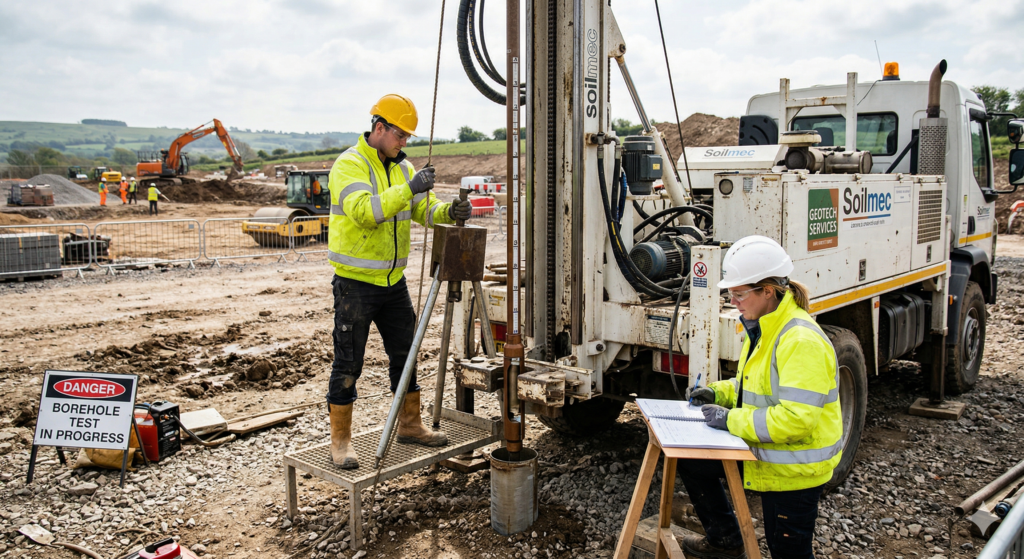
The method used to advance a borehole profoundly influences the quality and representativeness of samples and observations obtained. Recording the drilling method — and any changes within a borehole — is essential for subsequent interpreters to understand data limitations.
| Symbol | Method | Key Characteristics |
|---|---|---|
| ADV | Auger Drilling V-Bit (100 mm) | Efficient for soil; disturbs sample; not suitable for SPT without cleaning out the auger |
| AS | Auger Screwing | Variant of auger drilling |
| WB | Wash Boring | Uses water circulation; disturbs sample; cuttings returned as slurry |
| DHH | Down Hole Hammer | Percussive; suitable for hard rock; cuttings returned by air flush |
| PD | Percussion Drilling | Cable tool or similar; suitable for cobbles and boulders |
| HA | Hand Auger | Manual; suitable for shallow investigations; no rig access required |
| DT | Diatube (114 mm) | Large-diameter tube sampling |
| NMLC | NMLC Size Core Triple Tube | 50 mm diameter; triple-tube system minimises core disturbance |
| NQ3, HQ3, PQ3 | Wireline Size Core Triple Tube | 45 mm, 61 mm, 83 mm diameter respectively; preferred for rock investigations |
| NQ, HQ, PQ | Wireline Size Core Double Tube | 48 mm, 64 mm, 85 mm diameter respectively |
| RC | Reverse Circulation | Returns representative cuttings from depth; no core; efficient for deep holes |
| CA | Casing Advancer | Simultaneous casing and drilling for unstable ground |
| VC | Vibro Coring | Vibration-assisted tube sampling |
| SC | Sonic Coring | High-frequency vibration; excellent recovery in difficult ground; high cost |
| GP | Geoprobe Continuous Sampling | Direct push technology; excellent in soft ground; depth limited |
Drilling Support Methods
U— Unsupported — borehole advances without casing or fluid supportC— Casing — steel casing to prevent borehole collapseM— Mud — bentonite or polymer drilling fluid to support borehole walls and return cuttingsW— Water — water flush to return cuttings
Excavation Penetration Resistance
For trial pits and mechanically excavated investigations, the ease of excavation is recorded as: VE (Very Easy), E (Easy), F (Firm), H (Hard), or VH (Very Hard). This provides a practical, machine-independent record of material rippability useful for earthworks planning.
Core Recovery Indices: TCR, SCR and RQD
Three numerical indices are routinely calculated for each core run to quantify the quality and completeness of rock core recovery. These are among the most important quantitative data produced during a rock investigation.
Total Core Recovery (TCR)
TCR (%) is the ratio of total length of core recovered (including all pieces regardless of size or shape) to the total core run length, expressed as a percentage. TCR approaching 100% indicates nearly all material was recovered. Low TCR values indicate loss of material — which may reflect very weak, fractured, or voided rock washed away or broken apart during retrieval.
Solid Core Recovery (SCR)
SCR (%) is calculated similarly to RQD but includes all full-diameter core pieces regardless of length. SCR is less strict than RQD (which requires pieces at least 100 mm long) but stricter than TCR (which includes broken or partial pieces). It provides a useful intermediate quality indicator.
Rock Quality Designation (RQD)
RQD (%) is the most widely used rock mass quality index. It is defined as the sum of the lengths of all intact core pieces longer than 100 mm, divided by the total core run length, expressed as a percentage. Only pieces of full core diameter are counted.
| RQD (%) | Rock Mass Quality |
|---|---|
| 0–25 | Very Poor |
| 25–50 | Poor |
| 50–75 | Fair |
| 75–90 | Good |
| 90–100 | Excellent |
Groundwater Observations During Drilling
Groundwater conditions encountered during drilling are recorded in a dedicated column on the log. These observations are valuable for understanding the hydrogeological regime, identifying confined or perched aquifers, and assessing porewater pressure conditions relevant to stability analyses.
The following observation types are recorded:
- Water level (static): The measured depth to water after drilling has ceased and the water level has stabilised. Indicates the piezometric level.
- Water level (during drilling): The depth to water observed while drilling is in progress. Can be influenced by drilling fluid and is less representative than static readings.
- Water inflow: Water flowing into the borehole from the formation. Indicates a locally pressurised zone or a water-bearing fracture intersection.
- Water outflow: Drilling water flowing out of the borehole into the formation. Indicates a zone of low piezometric head or high permeability.
- Complete water loss: Total loss of drilling water circulation into the formation. Indicates very high permeability — often associated with open fractures, cavities, or karstic features.
These observations must always be accompanied by a depth and time notation. They are primary field observations and cannot be reconstructed after the event.
Practical Tips for Better Site Logging
Technical knowledge of the classification system is necessary but not sufficient for producing high-quality logs. Good logging also requires disciplined field practice, an understanding of common pitfalls, and a commitment to recording observations rather than interpretations.
Describe What You See, Not What You Expect
The most important principle of geotechnical logging is that the log must record primary observations — what is actually present in the sample or core — not what the logger expects based on prior site knowledge. Pre-existing knowledge is valuable for contextualising observations but must not drive what gets written on the log. An unexpected material is only surprising if it is faithfully recorded.
Record Changes Promptly
Soil and rock descriptions should be completed during or immediately after drilling each run or interval. Attempting to describe an entire borehole at the end of a shift from memory is an invitation for errors, inconsistencies, and the loss of critical observations. Core boxes should be laid out in order, photographed, and described before the drill rig moves to the next location.
Photograph Before and After Disturbance
A complete photographic record of all core boxes and significant samples is an invaluable supplement to written descriptions. Photographs capture colour gradations, fabric orientations, and textural details that are difficult to convey in text. Best practice is to photograph core before any samples are taken, providing a permanent record against which later queries can be checked.
Be Precise About Contacts
The depth and nature of geological contacts — transitions between different materials or units — are often as important as the description of the materials themselves. Is the contact sharp and planar, gradational over a few centimetres, or irregular? Is it horizontal, dipping, or undulating? These characteristics influence how the contact should be modelled and whether it represents a potential failure surface.
Use the Full Standard Vocabulary
The vocabulary of the AS1726-2017 system is carefully designed to be precise and unambiguous. Resist the temptation to use non-standard terms or abbreviations. If every log uses the same vocabulary, data from multiple boreholes on a site — or across multiple sites and projects — can be compared and interpreted consistently.
Distinguish Field Assessments from Laboratory Results
Field assessments of consistency, density, moisture, and rock strength are made under specific field conditions. Laboratory tests on the same material may give different values for legitimate reasons. Both data sets have value and neither supersedes the other. The log records the field assessment; laboratory test results are documented elsewhere and interpreted in relation to the field record.
Note Everything Unusual
Anything unusual — even if it falls outside the standard descriptive framework — should be recorded. This might be an unusual odour (suggesting organic content, contamination, or sulfide minerals), an unexpected colour, an unusual strength contrast, the presence of concretions or fossils, or a sudden change in drilling behaviour. At the time of drilling it is not always possible to know what is relevant — and the opportunity to observe these things passes with the drill rod.
Complete Summary Reference: Key Symbols at a Glance
| Category | Symbols | Meaning |
|---|---|---|
| Consistency (cohesive) | VS / S / F / St / VSt / H | Very Soft through Hard |
| Density (granular) | VL / L / MD / D / VD | Very Loose through Very Dense |
| Moisture | D / M / W | Dry / Moist / Wet |
| Rock Strength | VL / L / M / H / VH / EH | Very Low through Extremely High |
| Weathering | FR / SW / MW / HW / DW / XW / RS | Fresh through Residual Soil |
| Alteration | FR / SA / MA / HA / DA / XA / RS | Fresh through Residual Soil |
| Defect Types | P / J / S / SZ / MB / SH / CR / NF / SS / EW | Parting, Joint, Sheared Surface, etc. |
| Defect Planarity | PL / CU / UN / ST / IR | Planar through Irregular |
| Defect Roughness | vr / ro / sm / po / sl | Very Rough through Slickensided |
| SPT Special | RW / HW / HB | Rod Weight / Rod+Hammer Weight / Hammer Bouncing |
| Core Indices | TCR / SCR / RQD | Total, Solid, and Quality Designation recovery (%) |
| Excavation Resistance | VE / E / F / H / VH | Very Easy through Very Hard |
| Drilling Support | U / C / M / W | Unsupported / Casing / Mud / Water |
The complete body of knowledge summarised in this guide reflects years of refinement by the geotechnical profession, distilled into a standardised language that enables consistent communication across projects, disciplines, and time. Mastering this language is not merely a compliance exercise — it is the foundation of professional competence in geotechnical engineering and engineering geology.
Whether you are logging your first borehole or reviewing decades of logs on a complex investigation project, returning to the fundamentals of AS1726-2017 ensures that your descriptions and interpretations are built on solid, agreed ground — exactly as every engineered structure should be.