
INTRODUCTION
Unsealed road networks form a critical part of global transport infrastructure, particularly in regions where traffic volumes, economic constraints, or environmental conditions make sealed pavements impractical or unnecessary. Across rural, agricultural, defence, recreational, energy and mining sectors, unsealed roads serve as essential links enabling economic activity, community access, and asset connectivity.
Designing these pavements is a multidisciplinary task that brings together geotechnics, materials engineering, drainage design, traffic engineering, and asset management. Unlike sealed roads—where a bituminous or concrete surface layer provides substantial protection—unsealed roads rely almost entirely on the behaviour of granular materials and their interaction with moisture and load repetitions. Consequently, the governing performance mechanisms, the design considerations, and the maintenance expectations differ significantly.
The intent of this report is to provide a broad, accessible, and technically robust overview of unsealed road pavement design. It incorporates industry practice, engineering fundamentals, and established guidance from the Austroads Guide to Pavement Technology—particularly the section dealing with unsealed roads.
The content is general and not linked to any specific project, organisation, or site. Instead, it is structured to assist engineers, asset owners, graduate practitioners, and decision-makers who wish to deepen their understanding of this important pavement class.
THE ROLE AND IMPORTANCE OF UNSEALED ROADS
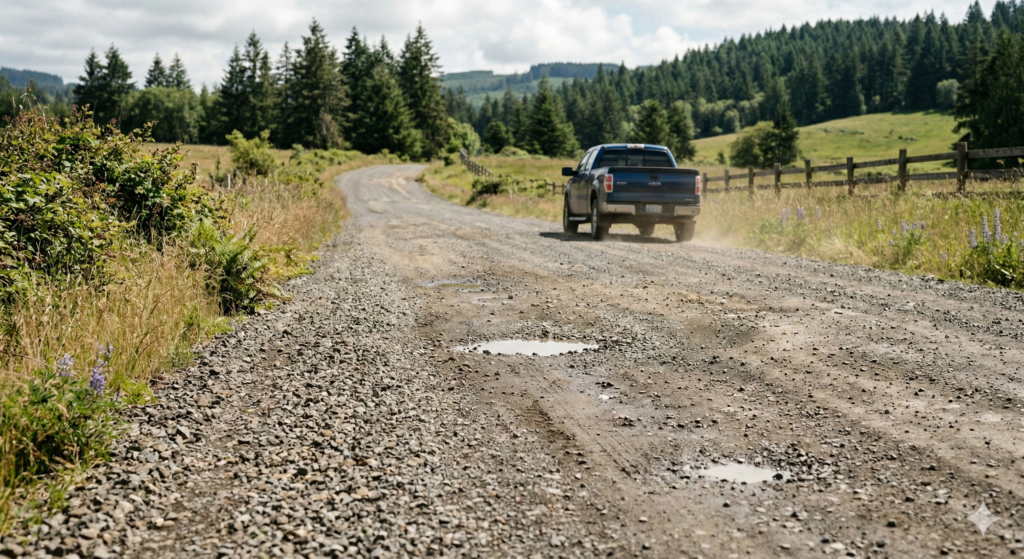
Unsealed roads may not carry the same prestige as highways or major arterials, yet they frequently serve as the structural backbone of transport networks in sparsely populated regions. In some jurisdictions, over 60% of the road network is unsealed.
Common Applications
Unsealed roads are used for:
- Rural access routes
- Agricultural and forestry roads
- Construction haul routes
- Mining and quarry access
- Utility infrastructure access (energy, water, telecommunications)
- Parks and recreational access tracks
- Defence and training areas
- Temporary construction-phase roads before final sealing
- Low-volume service, maintenance, and inspection routes
In many of these contexts, particularly remote areas, unsealed pavements must operate under wide climatic variations and complex load patterns.
Key Design Differences Compared to Sealed Pavements
While sealed pavements aim to minimise surface permeability and maximise structural life with minimal maintenance, unsealed pavements accept a fundamentally different performance model:
- Higher surface permeability
- Shorter serviceability cycles
- Regular regrading as planned maintenance
- Cyclical gravel loss and replacement
- Higher susceptibility to moisture ingress
- Greater sensitivity to material variability
Because of these factors, the cost-benefit balance shifts. Material quality requirements are generally lower, local material sources become more viable, and reliability targets may be reduced.
UNSEALED ROAD CLASSIFICATION (AUSTROADS)
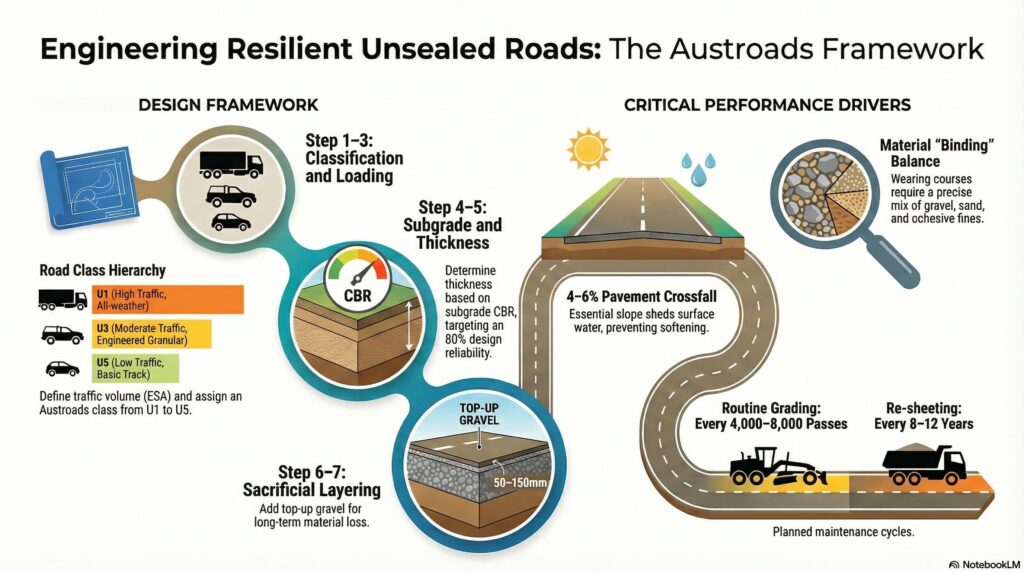
Austroads categorises unsealed roads into five classes (U1–U5), based on factors such as:
- Traffic volume and type
- Required level of service
- Design life
- All-weather accessibility
- Material availability
- Geometry and drainage requirements
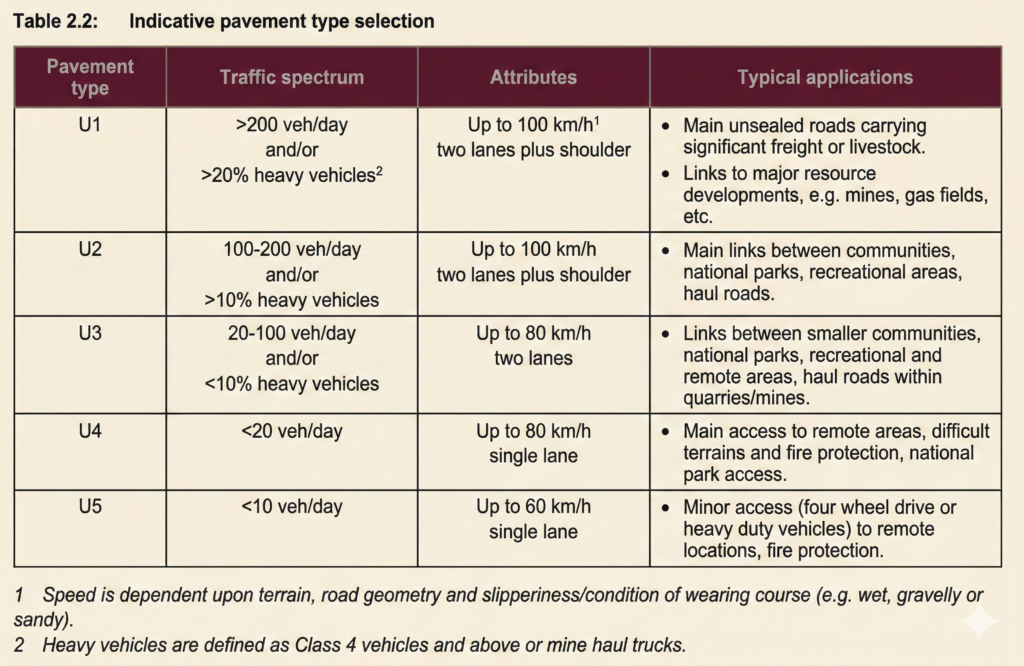
Pavement Types/Classes (Source: Austroads Guide to Pavement Technology Part 6: Unsealed Pavements)
Generally:
- U1: Highest standard; substantial traffic; all-weather accessibility required
- U5: Basic formed or cleared track; minimal traffic; may not require engineered granular structure
Selecting the correct class is critical, as it drives minimum thickness requirements, drainage standards, and material specifications.
DESIGN PHILOSOPHY AND OBJECTIVES
Unsealed road design aims to achieve a pavement structure that:
- Resists excessive rutting under expected traffic
- Maintains shape under rainfall events and wetting cycles
- Minimises gravel loss
- Ensures safety with acceptable skid resistance and ride quality
- Can be economically maintained over its lifecycle
Given the inherently permeable surface, moisture control becomes equally important as traffic loading.
DESIGN PROCESS (AUSTROADS-ALIGNED)
The design framework typically follows these steps:
Step 1: Establish Traffic Loading (ESA)
Traffic loading is typically expressed in terms of Equivalent Standard Axles (ESA), even though unsealed pavements often carry:
- Light vehicles
- Service utes
- Occasional trucks
- Machinery or specialised equipment
The empirical Austroads charts require cumulative ESAs over the design life. For temporary construction-phase roads, the ESA loading may be extremely high for a short period, followed by minimal operational traffic.
Step 2: Evaluate Local Material Options
Because unsealed roads prioritise cost-effectiveness, designers typically explore:
- Local natural gravels
- Crushed rock of subbase quality
- Processed or blended materials
- Stabilised insitu materials
- Local pit-run gravels
- Recycled crushed concrete
Material testing generally includes:
- CBR
- Grading distributions
- Atterberg limits
- Particle durability tests
- Moisture-density relationships
- Permeability assessments
Step 3: Determine Road Class
Using Austroads criteria (U1–U5), designers assess:
- Traffic characteristics
- Functional role
- Maintenance expectations
- Weather and access requirements
Once the class is selected, minimum requirements for thickness, geometry, and drainage are established.
Step 4: Determine Subgrade CBR and Environmental Factors
Subgrade assessment is crucial because:
- Unsealed surfaces allow more moisture infiltration
- Subgrades may soften during wet periods
- Localised weaknesses can cause early rutting
Testing should include:
- Laboratory CBR at various moisture conditions
- Field strength assessments
- Visual soil classification
- Consideration of climatic moisture cycles
Austroads assumes 80% reliability, meaning there is a 20% chance of requiring intervention earlier than the intended design life—considered acceptable given the low cost of repairs.
Step 5: Select Pavement Thickness Using Austroads Empirical Charts
The Austroads unsealed pavement charts provide total gravel thickness based on:
- Design CBR
- ESA loading
Designers must ensure the thickness:
- Meets minimums for the selected road class
- Allows for sacrificial layers
- Accounts for gravel loss over time
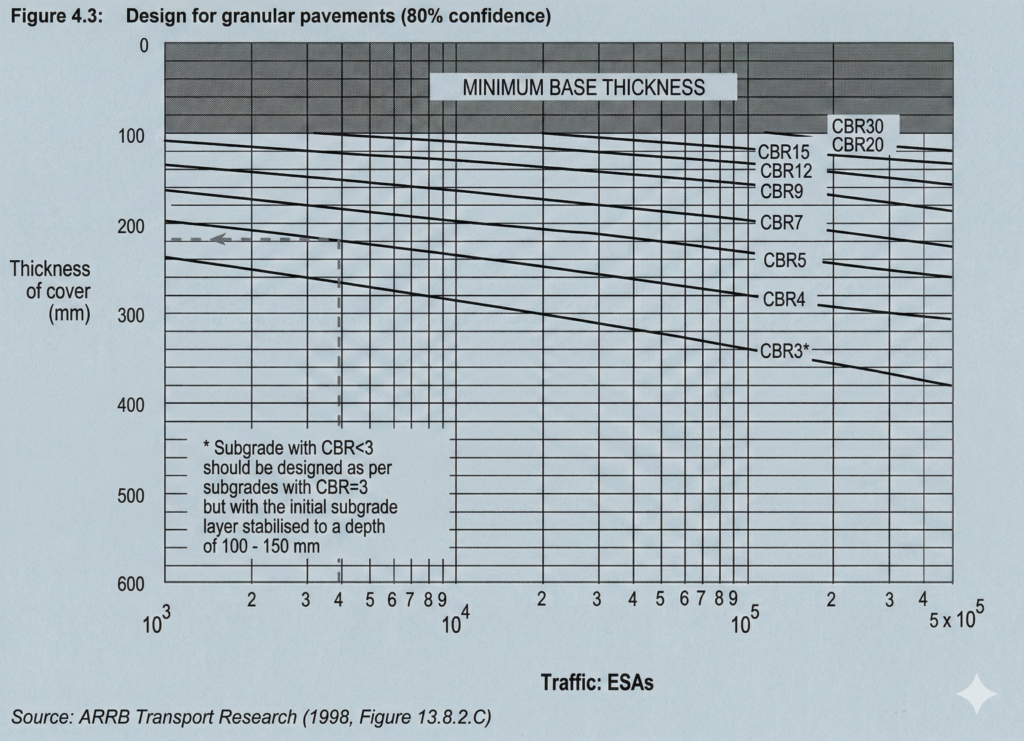
Pavement Thickness Design Curves
Step 6: Add a Sacrificial Wearing Course
Unsealed roads are expected to lose their wearing course over time. Designers generally allow:
- 50–150 mm of top-up gravel every 8–12 years
- Additional sacrificial thickness to withstand high construction traffic
- Maintenance cycles to reshape the surface periodically
Step 7: Finalise Layered Configuration
A typical structure may include:
- Wearing course (100+ mm)
- Basecourse (100+ mm)
- Subbase (optional depending on class)
- Subgrade
Layer types are selected based on material quality, construction viability, and moisture behaviour.
LAYER TERMINOLOGY AND STRUCTURAL BEHAVIOUR
Wearing Course
The wearing course must satisfy:
- Adequate binding and cohesion
- Resistance to tyre wear
- Low dust generation
- Good skid resistance
- Low permeability
Ideal material grading contains a balance of:
- Gravel
- Sand
- Fines (silt/clay)
Too many fines → slippery when wet
Too few fines → loose, dusty, unstable surface
Basecourse
Basecourse typically:
- Provides majority of structural stiffness
- Must have good CBR
- Should have moderate permeability
- May be same material type as wearing course if of sufficient quality
Subbase
Subbase is optional for lower classes but useful when:
- Subgrade is weak
- Additional separation is needed
- Local materials require blending
Subgrade
The subgrade is often the most variable part of the system. Designers must account for:
- Seasonal moisture fluctuations
- Potential for soft pockets
- Importance of drainage to prevent weakening
MATERIAL BEHAVIOUR AND SELECTION
Material Types
Materials for unsealed pavements may include:
- Natural gravels
- Crushed rock (not high-end basecourse quality)
- Blended local sands and gravels
- Recycled crushed materials
- Stabilised insitu soils
- On-site quarry products
- Screened or processed local materials
Key Strength Considerations
Key metrics include:
- CBR (California Bearing Ratio)
- Shear strength / aggregate durability
- Moisture sensitivity
- Compaction characteristics
- Grading distribution
- Plasticity Index (PI)
Permeability
Permeability profoundly influences performance:
- Excess moisture weakens both wearing-course and subgrade
- Low permeability is preferred for wearing course
- Austroads suggests maximum permeabilities on the order of:
- Wearing course: ~1×10⁻⁴ m/s
- Base/subbase: ~1×10⁻³ m/s
Workability and Compaction
Engineers must evaluate:
- Ease of achieving compaction
- Moisture-density relationships
- Sensitivity to moisture variation
- Rolling effort required
Steep moisture-density curves indicate moisture-sensitive materials that may be difficult to compact uniformly.
GEOMETRY AND DRAINAGE DESIGN
Drainage is arguably more critical for unsealed roads than for sealed pavements because surface permeability allows moisture migration downward.
Crossfall
Unsealed pavements typically require:
- 4–6% crossfall, compared to 2–3% for sealed roads
- Faster surface water shedding
- Better resilience to shape loss before ponding occurs
Longitudinal Gradient
While gradients of ≤8% are preferred, steeper grades may be permitted if:
- Material quality is high
- Additional drainage is provided
- Surface traction remains sufficient
Drainage at Sags
Sags require:
- Extra attention
- Subsurface drainage if needed
- Higher quality material to resist moisture-related softening
Edge Drainage and Swales
Designers aim to:
- Provide adequately sized swales
- Avoid boxing in the pavement
- Allow free drainage away from the structure
PERFORMANCE MECHANISMS
Performance of unsealed pavements is governed by the interaction between:
Traffic Factors
- Traffic volume
- Load repetitions
- Tyre pressures
- Traffic speed
- Vehicle type (4WD, heavy rigid, tracked equipment, etc.)
Moisture Factors
- Infiltration from rainfall
- Water retention in fines
- Seasonal fluctuations
- Groundwater levels
Combined Effects
Typical distresses include:
- Rutting
- Shape loss
- Corrugations
- Potholes
- Gravel loss
- Slippery surfaces
- Scour and erosion
- Crossfall deformation
GRAVEL LOSS: A KEY PERFORMANCE DRIVER
Gravel loss impacts:
Road Users
- Increased roughness
- Decreased skid resistance
- Reduced visibility (dust)
- Higher vehicle wear
- Reduced travel speed
Asset Owners
- Reduced pavement thickness
- Increased maintenance cycles
- Greater likelihood of potholes
- More frequent re-sheeting
Environment
- Dust and habitat impact
- Increased resource extraction
- Higher vehicle emissions due to roughness
MAINTENANCE REQUIREMENTS
Ongoing maintenance is integral to the lifecycle of an unsealed road.
Common Maintenance Activities
- Regular grading (every 4,000–8,000 vehicle passes)
- Pothole patching
- Reshaping of crossfall
- Clearing of drainage lines
- Re-sheeting every 8–12 years
- Dust suppression where needed
Maintenance frequency depends on:
- Traffic loading
- Rainfall patterns
- Material quality
- Surface geometry
DESIGNING FOR SPECIALISED VEHICLES
In some applications, unsealed roads must support:
- Heavy transport
- Multi-axle large cranes
- Mining haul vehicles
- Agricultural machinery
- Tracked vehicles
Standard ESA methods may be insufficient. In such cases, designers may:
- Use strain-based analysis
- Refer to mining haul-road design methods
- Apply increased safety factors
- Enhance material specifications
RISK, RELIABILITY, AND DESIGN LIFE CONSIDERATIONS
Unsealed pavements embrace managed risk through:
- 80% reliability target
- Acceptance of periodic intervention
- Lower upfront cost
- Fit-for-purpose serviceability
The design life may include:
- 2–5 years (temporary works)
- 10–20 years (permanent but low-volume routes)
- Multi-decade lifecycles with periodic resheeting
INCORPORATING SUSTAINABILITY AND RESOURCE EFFICIENCY
Sustainability is increasingly important:
Local Material Use
Reduces haulage impacts and carbon emissions.
Recycled Materials
Crushed concrete and blended stabilised materials can be viable.
Reduced Quarry Dependence
Optimising grading and compaction reduces the need for high-quality quarried products.
THE FUTURE OF UNSEALED ROAD DESIGN
Emerging approaches include:
- Data-driven condition monitoring
- GPS-enabled grading equipment
- Improved dust suppression technologies
- More sophisticated material stabilisation techniques
- Use of geosynthetics in soft subgrade zones
- Machine-learning-based deterioration modelling
These innovations strengthen economic and environmental performance.
CONCLUSION
Unsealed road pavement design is a nuanced and technically rich discipline. It requires a deep understanding of granular material behaviour, hydrology, geometry, and traffic engineering. Unlike sealed pavements, these structures demand a holistic approach that balances performance, cost-effectiveness, material availability, and maintenance philosophy.
By applying principles aligned with Austroads guidance, designers can create robust, sustainable, and reliable unsealed road networks capable of supporting diverse industries.
This report provides an integrated overview suitable for professional audiences, decision-makers and engineers committed to delivering resilient infrastructure.



Pingback: Civil Engineering Design for Battery Energy Storage Systems (BESS) in Australia - Civil and Structural Engineer